Indianapolis Emergency Roofing Service Areas

Comprehensive emergency storm damage, hail inspection, and roofing triage dispatch directory covering Marion, Hamilton, and Johnson counties.
Roof Expert USA provides 24/7 emergency storm damage triage and independent roofing contractor dispatch across Indianapolis, Marion County, Hamilton County, Johnson County, and the greater Central Indiana metropolitan region. Whether your residential roof in Carmel suffered severe hail stone impact, your commercial flat roof in Fishers has acute ponding, or straight-line wind squalls tore shingles in Greenwood and Noblesville, our referral network connects you with vetted, licensed local roofing specialists ready for immediate emergency stabilization.

Central Indiana Regional Dispatch Coverage

The Indianapolis metropolitan area occupies a vast geographical plain subject to severe weather convergences. Thunderstorm supercells tracking eastward across Indiana regularly drop destructive hail swarms and straight-line winds exceeding 70 mph across Marion, Hamilton, and Johnson counties. Dispatched roofing contractors maintain fully equipped service vehicles throughout the primary coverage corridors to ensure rapid dispatch across all communities.

Featured Regional Suburb Coverage

Hamilton County Premier

Carmel Roof Repair

High-end architectural shingle, natural slate, and designer metal roofing systems. Comprehensive forensic hail stone impact testing and precision storm leak triage.

Carmel Dispatch Details →
East Hamilton Corridor

Fishers Storm Damage

Suburban family subdivisions and commercial low-slope properties. Rapid dispatch for wind shingle blowouts, emergency tarping, and insurance claim documentation.

Fishers Dispatch Details →
Historic & Growing North

Noblesville Roof Tarping

Severe post-storm roof exposure stabilization, heavy-duty 10-mil poly timber-batten tarping, tree limb puncture shoring, and structural rafter anchor fastening.

Noblesville Dispatch Details →
Johnson County South Hub

Greenwood Roof Leak

High-density residential communities and commercial retail roofs. Triage for active ceiling leaks, cracked plumbing vent pipe collars, and winter ice dam backups.

Greenwood Dispatch Details →

Westfield, Zionsville & Metro Service Scope

In addition to our four primary suburban hubs, Roof Expert USA's dispatch desk coordinates emergency service across the broader Central Indiana region, including:

  • Westfield, IN: Rapidly expanding residential communities near Grand Park experiencing windward roof exposure and hail strikes. Dispatched teams provide rapid architectural shingle replacement and valley flashing repairs.
  • Zionsville, IN: Historic village estates and wooded suburban properties with mature tree canopies. Contractors specialize in steep-slope timber-batten tarping, limb puncture repair, and copper flashing preservation.
  • Indianapolis Urban Core & Historic Districts: Downtown, Meridian-Kessler, Broad Ripple, Irvington, Woodruff Place, and Fountain Square (specializing in historic brick masonry chimney flashing and flat roof additions).
  • Outer Metro Communities: Avon, Brownsburg, Plainfield in Hendricks County, and Lawrence, Beech Grove, and Speedway in Marion County.

Frequently Asked Questions

What areas around Indianapolis do your dispatched contractors cover? +

Dispatched independent roofing contractors cover all of Indianapolis and Marion County, as well as Carmel, Fishers, Noblesville, Westfield, and Zionsville in Hamilton and Boone counties, and Greenwood in Johnson County.

How quickly can emergency tarping crews arrive at suburban locations? +

Depending on severe storm traffic and weather road conditions, on-call contractors typically reach suburban locations in Carmel, Fishers, Noblesville, and Greenwood within 60 to 120 minutes of dispatch confirmation.

Does RoofExpertUSA charge homeowners for dispatching contractors? +

No. RoofExpertUSA operates as a free referral and emergency intake service for property owners. All project estimates, diagnostic fees (if applicable), and contractual scopes are agreed upon directly between the homeowner and the independent contractor.

Midwest Regional Technical Engineering & Storm Protocols

1 Regional Microclimate Dynamics & Midwest Hail Belt Exposure

Central Indiana occupies a prime corridor within the Midwest Hail Belt. Convective supercells sweeping across the flat plains encounter thermal updrafts over the urban Indianapolis heat island, triggering intense hail cores with ice stones measuring from 1.0 inch to over 2.0 inches in diameter. These ice projectiles strike steep-slope residential roofs at terminal velocities exceeding 75 to 90 miles per hour, fracturing brittle asphalt binders and causing severe latent fiberglass mat bruising.

Furthermore, Indianapolis experiences sharp winter temperature plunges followed by rapid mid-winter thaws. Alternating freeze-thaw cycles foster destructive ice damming along exterior roof eaves, pushing meltwater upwards beneath shingle laps and swamping unsealed valley flashings across Marion, Hamilton, and Johnson counties.

2 Non-Destructive Moisture Diagnostics & FLIR Thermal Tracing

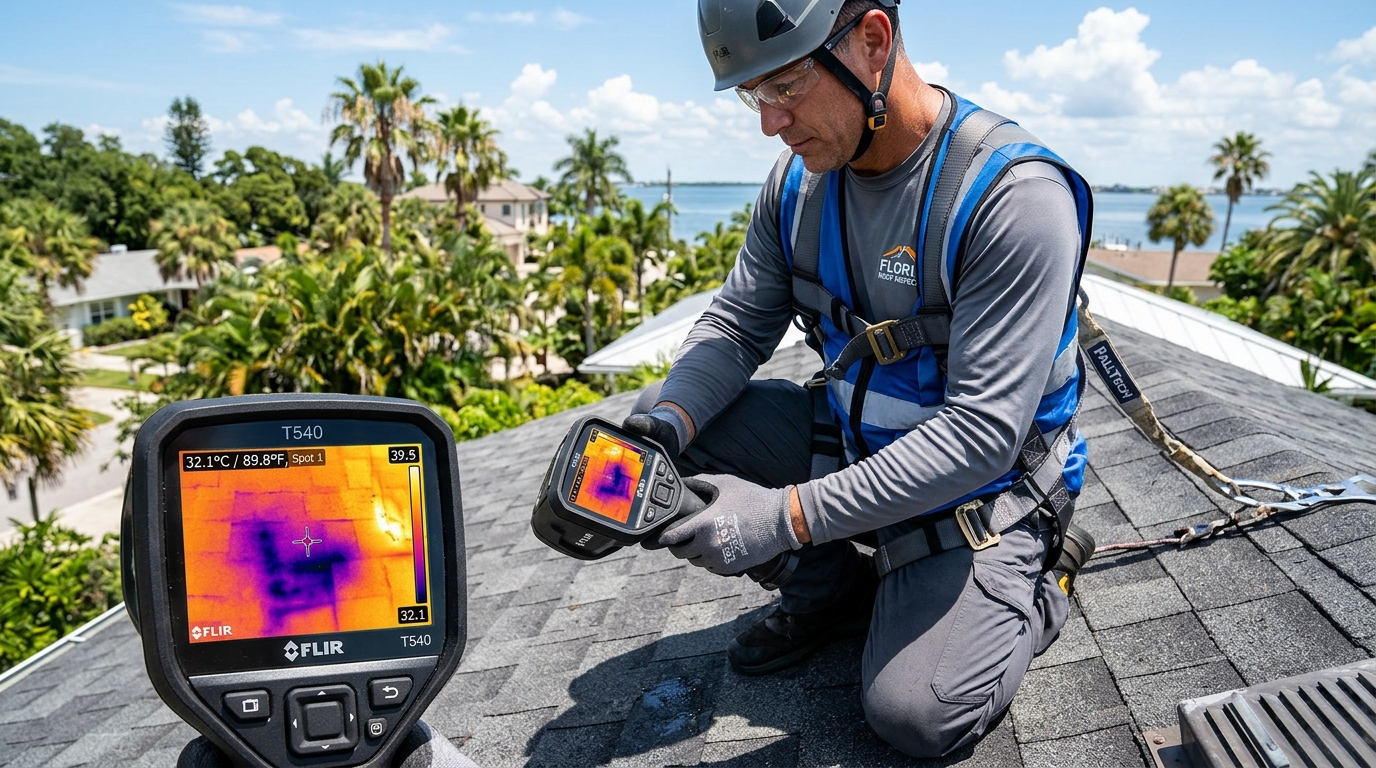
Visual surface inspections alone cannot reveal internal roof decking saturation or moisture tracking along hidden rafter lines. Dispatched independent roofing specialists utilize high-resolution FLIR infrared thermal imaging cameras during evening cooling cycles. Trapped moisture inside wet fiberglass or cellulose insulation retains heat longer than dry materials, creating high-contrast thermal signatures that pinpoint the exact boundaries of active leak zones.

Non-destructive dielectric capacitance impedance meters and digital pin-probe moisture sensors measure sub-surface moisture percentages without damaging architectural shingle membranes, establishing empirical data required for accurate insurance claim reports.

3 Step-by-Step Substrate Restoration Methodology

Permanent restoration follows a rigorous four-phase protocol: (1) Defective shingle courses and rotted plywood sheathing are excised down to sound timber rafters; (2) Structural rafters are sistered or reinforced with kiln-dried dimensional lumber if compromised by limb impacts; (3) Self-adhering high-temperature SBS-modified ice-and-water barrier underlayments are installed across eaves, valleys, and rakes; (4) Class 4 impact-resistant architectural shingles or commercial single-ply membranes are hand-sealed with high-wind butyl mastics to resist straight-line gusts up to 130 mph.

4 Indiana Building Energy Codes & Contractor Licensing Compliance

All roofing installations in Central Indiana must adhere to the Indiana Residential Code (675 IAC 14) and local municipal amendments enforced by the Indianapolis Department of Business and Neighborhood Services (BNS). Under Indiana building mandates, ice-barrier underlayments extending minimum 24 inches inside the interior heated wall line are strictly required on all eaves.

Dispatched contractors verify active business registration through the Indiana Secretary of State, maintain active General Liability insurance ( minimum) and Indiana Workers' Compensation coverage, and pull all required municipal building permits prior to permanent reconstruction.

5 Preventative Property Maintenance & Winter Ice Dam Preparedness

Proactive maintenance shields properties against costly emergency damage:

  • Biannual Flashing & Pipe Collar Audits: Inspect rubber pipe boots for UV ozone cracking and chimney reglet joints for cracked mortar before winter freeze-thaw cycles begin.
  • Attic Ventilation & R-Value Insulation Checks: Maintain minimum R-38 to R-49 ceiling insulation and unblocked soffit baffles to prevent warm attic air from creating eave ice dams.
  • Post-Hail Soft Metal Checks: After severe summer storms, examine aluminum box vents and gutters for hail dimpling to catch latent shingle bruising early.
  • Commercial Drain Sump Clearing: Ensure flat roof internal drains and overflow scuppers remain clear of organic debris to eliminate 48-hour structural ponding.
CALL NOW — (888) 208‑4155